
 Egypt Musings
 |
Area: 1,002,000 sq km (386,874 sq mi) |
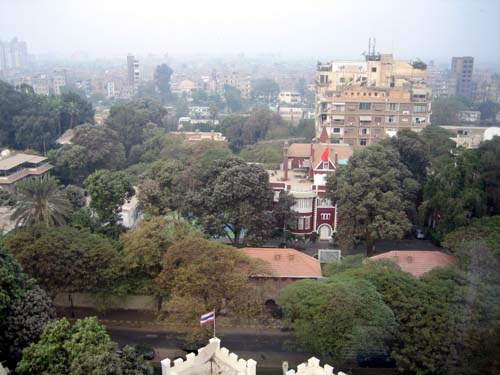 |
| Above, the view from our hotel room on Zamalek island in the city of Cairo. |
We found Cairo to be lively and chaotic. The days were comfortably warm and the nights were chilly. At all hours the streets were clogged with older model cars whose drivers don't stop for red lights or pedestrians. Bold locals darted between cars who might give way, sometimes with children in tow. Of our collective travels, this family found Cairo to have the most lawless and frenetic flow of automobiles we've witnessed. Thousands of beat-up black and white Peugeot taxis were skillfully maneuvered the streets, leaving but a few inches alongside double-parked and haphazardly-parked cars, and drivers tooted horns or flashed headlights at night in warning. To see a recent model car in good condition was nearly as rare as spotting a Ferrari in a large U.S. city. Broken sidewalks caused those on foot to walk in the streets where garbage piled along the curbs and small cats scampered about. Forty percent of Egyptian men smoke cigarettes, adding to air pollution and ever-present sand blown in from the Sahara desert. City architecture was covered in dirt and dust, but it didn't detract from the beauty of the older buildings. Photos and flags of a younger President Mubarek were everywhere -- I saw a rug woven with his image. My brother-in-law Kuan was at the end of his six-month work assignment and he lived on one of Cairo's two large islands along the Nile, Zamalek, where embassies and consulates are -- Oman's was directly across from his apartment. These stately structures were guarded by rifle-carrying soldiers. In the working areas of Cairo, herders with flocks of 30 sheep coexist with cars, carts pulled by galloping donkeys and horses. Sometimes we saw people carrying huge loads atop their heads. From beautiful and richly decorated mosques all over Cairo, also known as the “City of 1000 Minarets,” the call to prayer blared loudly from speakers five times daily. Muslims not at mosques laid their rugs in the direction of Mecca (in Saudi Arabia). Looking carefully in our hotel rooms, we noticed “Qibla” arrows pointing the way, on the ceiling or under the glass of a table. Prayers were made at the train station, the airport, in shops, wherever people are. Muslim women wore hijaabs (head scarves) to fashionably coordinate with their clothing. Women and men (but not all) dressed in traditional long gelabayas over pants. We wore long sleeves and long pants and, to enter mosques, we removed our shoes. Any eye contact with men was immediately mistaken for brazenness (who, me?), so studying male faces was not an option for me. It was hard not to because their coloring is beautiful: dark skin with long lashes over dark eyes, some with pale eyes of hazel green and blue. Young women seemed curious about me, staring first and then returning my smiles, but Kuan got the most attention with his waist-length hair . Because most women in this society work in their homes, nearly all services in our hotels and transportation were performed by men. In the tourist areas, souvenir hawkers drove us nuts with constant touts, none of which were original ("Excuse me, China? Japan? Korea?"). |

Next Page |